
Jane Migdol March 4, 2026
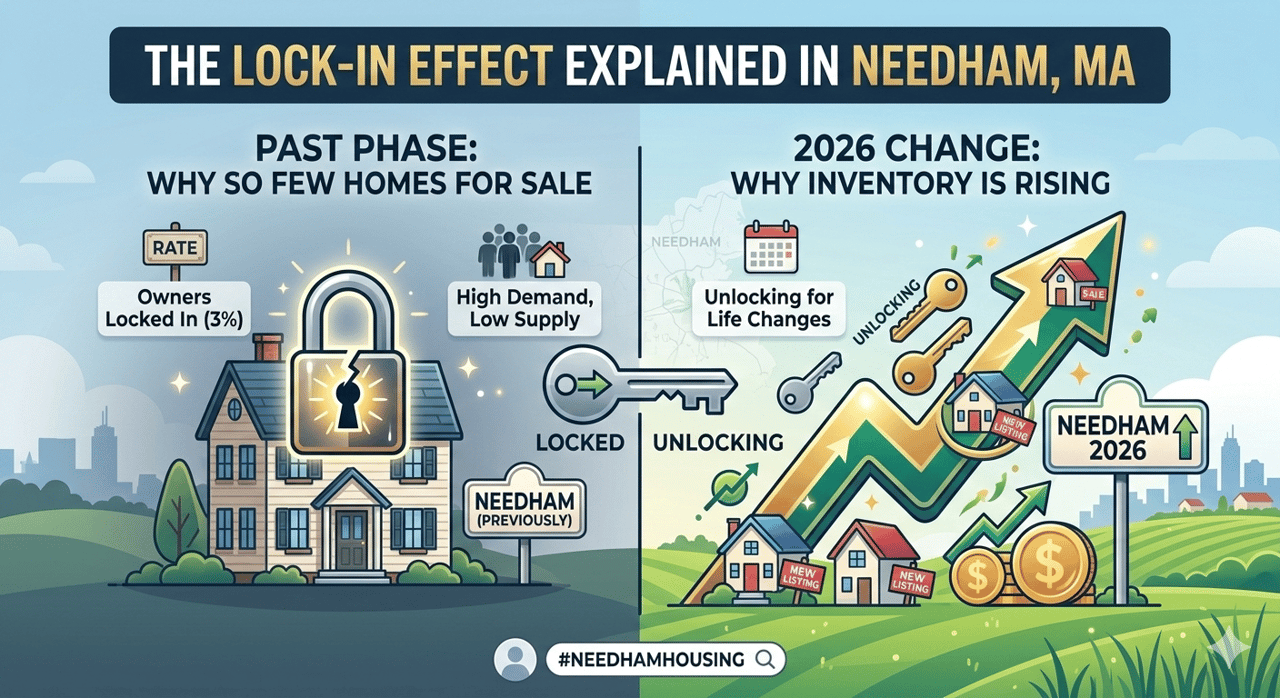
• The lock in effect kept many Needham homeowners from selling because their mortgage rates were far below current market rates.
• Ultra low rates from 2020 through 2022 created a supply freeze across Needham, Newton, Wellesley, and Natick.
• Inventory in 2026 is gradually improving as life events outweigh rate hesitation.
• Buyers now have more choices than they did in 2022 and 2023, but pricing remains disciplined in strong neighborhoods.
• Sellers who waited may face a more competitive listing environment than in the peak shortage years.
For the past several years, one question has dominated real estate conversations in Needham: Why are there so few homes for sale?
The answer is rooted in what economists call the lock in effect. Homeowners who secured mortgage rates between 2.5 percent and 3 percent during the pandemic years were financially disincentivized from moving when rates climbed above 6 percent. In a town like Needham, where long term ownership is common and property values have steadily appreciated, that effect was amplified.
In 2026, that dynamic is shifting. Inventory is still historically constrained, but it is no longer frozen. Buyers and sellers in Needham, Newton, Wellesley, and Natick need to understand what changed and what it means for their next move.
Needham remains one of the most stable and resilient markets in Greater Boston. Demand is driven by commuter convenience, strong public schools, and a limited supply of buildable land. According to regional data sources such as MLSpin and national housing trackers like Zillow and Realtor.com, the broader Boston suburbs experienced a measurable inventory shortage between 2022 and 2024 compared with pre pandemic norms.
The Federal Reserve rate hikes that began in 2022 pushed borrowing costs higher. Freddie Mac reported a rapid rise in average 30 year mortgage rates during that period. As a result, homeowners who locked in historically low rates chose not to sell. In Needham, this translated into fewer listings, compressed spring inventory, and multiple offer situations that became routine rather than exceptional.
By early 2026, however, inventory levels have begun to normalize modestly. Not surge. Not oversupply. But movement.
The shift is not driven by collapsing prices or distress. It is driven by life.
The lock in effect occurs when homeowners hold onto their property because replacing their current mortgage would significantly increase their monthly payment.
Consider a Needham homeowner who purchased in 2021 with a 2.75 percent mortgage. Moving in 2023 or 2024 often meant accepting a rate near 6.5 percent or higher. Even with strong equity gains, the payment shock was substantial. That financial friction suppressed listing activity.
In towns like Newton and Wellesley, where average sale prices are higher, the impact was even more pronounced. A rate increase on a million dollar property produces a meaningful difference in carrying costs. Many homeowners chose renovation over relocation.
In Natick, where a mix of price points attracts both move up buyers and first time purchasers, the shortage created intense competition in the mid price tiers.
The result across these towns was clear. Demand remained strong. Supply stayed tight. Prices held firm.
The lock in effect was powerful, but it was never permanent.
Three structural factors are now loosening inventory:
Relocations, downsizing, divorce, estate sales, and job changes cannot always wait for perfect rates. In 2026, accumulated deferred moves from prior years are entering the market.
While rates are not at pandemic lows, the extreme volatility of 2022 and 2023 has eased. When buyers and sellers can model payments with more confidence, transactions increase.
Home values in Needham appreciated significantly over the past five years. Sellers who purchased before or during 2020 often have substantial equity. That equity offsets higher borrowing costs on their next purchase.
This is why inventory is improving without triggering price declines. It is normalization, not correction.
Buyers in 2026 face a different landscape than they did two years ago.
They still encounter competition for well priced homes in prime neighborhoods near commuter rail stops or top elementary schools. However, the extreme scarcity that defined the peak lock in years has softened.
Buyers now benefit from:
• More listing options during the spring and early fall markets
• Fewer all cash dominated bidding wars in mid range price points
• Greater negotiating leverage on homes that are overpriced
That said, discipline is critical. Overpaying in a normalized inventory environment is different from competing in a severe shortage. Buyers should focus on long term suitability rather than short term urgency.
For local data trends and neighborhood breakdowns, buyers should reference updated market reports on janemigdol.com, where hyperlocal insights matter more than national headlines.
Sellers no longer operate in an artificially supply starved environment.
In 2022, nearly any well maintained property in Needham could attract multiple offers within days. In 2026, pricing precision matters again.
Sellers should focus on:
Strategic pricing based on current comparable sales, not 2022 peak anecdotes
Professional preparation including staging and presentation
Timing around peak buyer demand windows in spring and early fall
Understanding competing inventory in both Needham and nearby towns such as Wellesley and Newton
The days of automatic escalation are fading. Strong properties still command strong results. Average properties must compete.
2023 Market Conditions
• Extremely low inventory
• High rate shock
• Intense competition for limited listings
• Sellers had clear leverage
2026 Market Conditions
• Gradually increasing inventory
• Rate stability relative to prior volatility
• Balanced negotiation dynamics
• Greater emphasis on property specific value
This is not a buyer market. It is not a distressed market. It is a transitioning market.
Many homeowners had mortgage rates below 3 percent. Selling would have required replacing that loan with a significantly higher rate, which discouraged moves.
It is weakening, not disappearing. Life events and accumulated equity are bringing more listings to market, but low rate mortgages still exist.
Inventory growth has been measured. Prices remain supported by strong demand, limited land, and desirable schools.
Timing rates perfectly is rarely effective. Buyers should evaluate affordability, long term plans, and local inventory rather than speculate on short term rate changes reported by sources like Freddie Mac or the Federal Reserve.
Yes. Similar patterns are visible in Newton and Wellesley, where high purchase prices magnified the lock in effect.
Natick generally offers more varied price points. However, well located properties remain competitive, particularly near commuter routes.
The lock in effect distorted normal market behavior for several years. It created artificial scarcity that pushed urgency and compressed decision timelines.
In 2026, we are returning to a more rational environment. Sellers must compete thoughtfully. Buyers must analyze carefully. Neither side should assume conditions from 2022 still apply.
The most successful transactions this year are grounded in data from MLSpin, supported by broader trends reported by Zillow and Realtor.com, and interpreted through local, on the ground expertise.
The lock in effect explains why so few homes were available in Needham and surrounding towns over the past several years. Historically low mortgage rates froze supply and intensified competition.
That chapter is evolving.
Inventory is increasing gradually as life circumstances override rate hesitation. Buyers have more options. Sellers face more competition. The market is stabilizing, not unraveling.
Clear strategy matters more than ever.
I have spent decades advising buyers and sellers in Needham, Newton, Wellesley, and Natick. My focus is on data driven pricing, disciplined negotiation, and protecting long term equity. If you are considering a move in 2026, I provide candid guidance grounded in local experience and real time market analysis.
April 16, 2026
April 2, 2026
March 24, 2026

March 15, 2026
March 12, 2026
March 5, 2026
March 4, 2026
March 3, 2026
February 27, 2026
With a curated approach to real estate, Jane Migdol combines market expertise with a deep appreciation for design, architecture, and lifestyle. Her clients benefit from refined strategy, global reach, and a personal touch that transforms the buying and selling experience into something truly remarkable. When you work with Jane, you’re not just making a move — you’re elevating your way of living.