
June 4, 2026
If you are thinking about moving to Needham, one of the first questions you may have is simple: what does each part of town actually feel like day to day? That is an important question, especially in a town where the overall footprint is fairly compact, but the rhythm of daily life can still shift from one area to another. In this guide, you will get a practical feel for Needham Center, Needham Heights, Needham Junction, Needham Crossing, and the quieter residential pockets so you can picture what may fit your lifestyle best. Let’s dive in.
Needham is a suburban town of about 32,931 residents spread across 12.3 square miles. It is largely residential, and single-family detached homes make up 77.6% of the housing stock. Census estimates also show a median household income of $212,241, a median owner-occupied home value of about $1.146 million, and an owner-occupancy rate of 84.3%.
Those numbers help explain the feel of the town. Needham is not a place of sharply divided districts or a dense urban grid. Instead, it tends to offer a mix of village-style centers, commuter-oriented areas, and quieter residential streets within a relatively short distance of one another.
If you want the part of Needham that feels closest to a traditional downtown, Needham Center is the clearest match. Town planning materials describe the broader downtown study area as including the Center Business district, the Chestnut Street Business district, and the Highland Avenue business district, with a focus on a mixed-use local downtown shopping district.
Day to day, this is the area that tends to feel the most walkable and the most active. The Common and Town Hall area is described by the town as having a pedestrian-friendly scale with shops and eateries nearby. That gives this part of Needham a familiar, village-style rhythm where errands, dining, and local activity are more closely clustered.
That said, Needham Center is not static. The town is actively working through the Envision Needham Center process, which focuses on traffic, parking, pedestrian safety, and economic vitality. If you are exploring this area, it is helpful to think of it as evolving, not fixed.
Even within the center, the streetscape can shift. Town documents note that Chestnut Street south of the Common feels more auto-oriented, with parking lots and building setbacks. So while the broader area reads as the most village-like part of Needham, some sections may feel less compact than others.
For many buyers, that mix can be a plus. You get access to the town’s most traditional center while still seeing the practical side of suburban planning and parking. It is often a good fit if you want activity nearby without expecting a fully urban downtown experience.
Needham Heights tends to feel more like a neighborhood center than a classic downtown. Town planning documents describe it as a transit-oriented neighborhood center, with attention focused along Highland Avenue, Hillside Avenue, and Avery Square within a half-mile of Needham Heights station.
In daily life, this area often feels especially useful. Train access, everyday errands, and local services sit relatively close together, which can make routines feel efficient. If your week revolves around commuting, grabbing what you need locally, and staying connected to town activity, Needham Heights often stands out.
Another part of the area’s identity is The Center at the Heights. The town describes it as a community-services anchor offering social, recreational, educational, and health-oriented programming. That adds another layer to the neighborhood feel and helps explain why this area can feel practical and connected at the same time.
The retail block at West Street and Highland Avenue is another key part of the area. The town notes that this block is home to thriving businesses. That reinforces the sense that Needham Heights functions as a day-to-day hub where errands and routines can feel straightforward.
Compared with Needham Center, the feel here is usually less about a classic town core and more about convenience. Many buyers see it as one of the town’s clearest examples of a neighborhood center built around transit and everyday use.
Needham Junction is best understood as a transition area rather than a stand-alone village center. The town’s planning and mobility documents group it with Needham Center and Needham Heights as one of Needham’s three MBTA station neighborhoods along the Highland Avenue and Chestnut Street spine.
In practical terms, this area often feels connected more than concentrated. You are close to rail access and close to other town activity, but the area is not described as being as retail-heavy as Needham Center or as business-dense as Needham Crossing. That creates a more in-between feel.
For some buyers, that is exactly the appeal. If you want access to transportation and the broader flow of town life without centering your search on a village-style district, Needham Junction may feel like a sensible middle ground.
The town’s rail trail study begins near Chestnut Street and the Junction station and runs toward the Charles River and the Dover border. That adds to the area’s identity as a connector. It is a place tied not only to commuting routes, but also to movement through town and toward open-space areas.
Needham Crossing has the most corporate and employment-oriented feel in town. According to the town, it combines residential, office, retail, restaurant, and consumer-service uses, and it already includes high-tech and life science employers.
This is the part of Needham that feels least like a traditional village center. Instead, it reads more as a mixed-use corridor shaped by jobs, access, and infrastructure. If you are picturing a classic main street, this is probably not the image that comes to mind.
At the same time, Needham Crossing is not only about office space. It is framed by outdoor amenities including Cutler Lake Park and the Charles River, and current Route 128 and Highland Avenue infrastructure projects are intended to improve access and multimodal travel. So while the area feels more modern and corridor-like, it still connects to the broader outdoor life that runs through Needham.
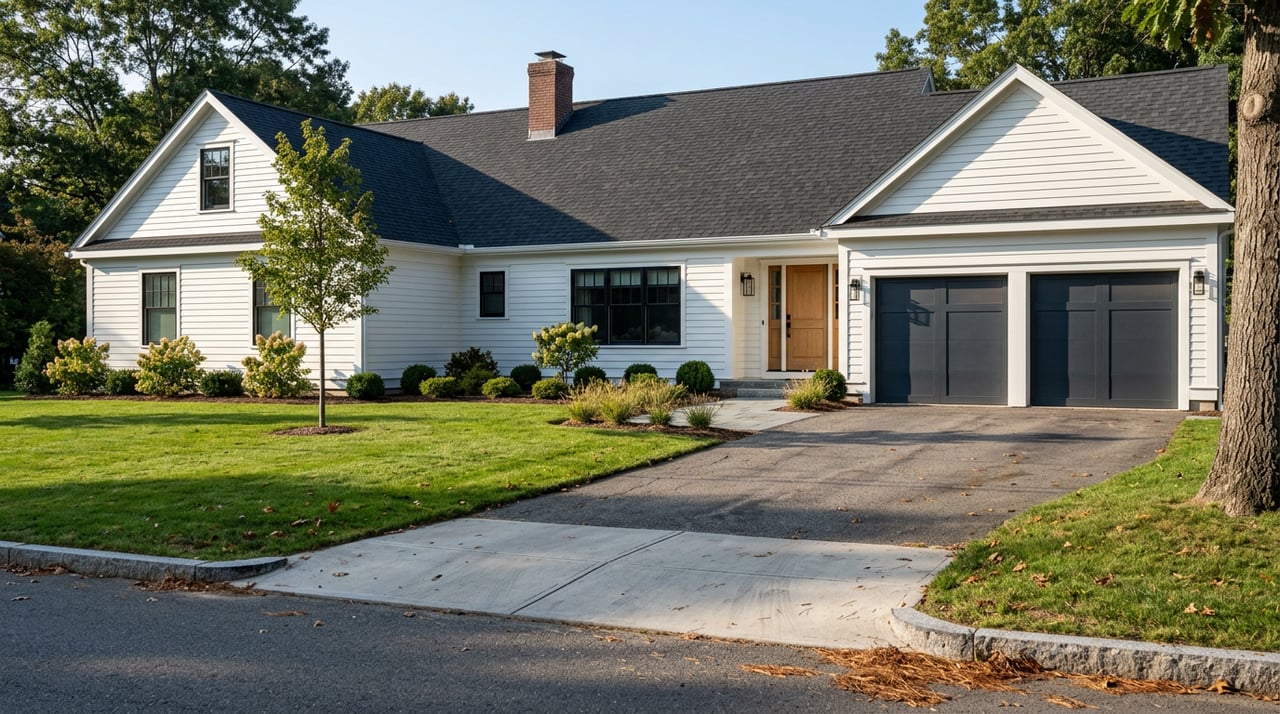
Outside the village cores and station areas, Needham reads as a largely single-family town. That aligns with the housing data and the town’s housing plan, which notes that the housing stock remains dominated by single-family detached residences.
The practical day-to-day feel in these areas is usually more private, more tree-lined, and more car-oriented than in the station districts. Town planning documents also show that density is meant to step down as development approaches surrounding single-family neighborhoods. In simple terms, the farther you move from the core activity areas, the more residential the feel tends to become.
The housing plan references pockets such as Clarke Road, Rolling Lane, Forest Street, Brookside Road near the Wellesley line, and the east side of Greendale Avenue. These references help illustrate the broader point: much of Needham’s identity is still shaped by lower-rise residential streets rather than concentrated mixed-use development.
The town’s current housing plan places more housing intensity within a half-mile of Needham Heights, Needham Center, and Needham Junction stations. That means the strongest pressure for change is concentrated near transit. Outside those areas, much of Needham remains primarily low-rise and residential.
For buyers and sellers, that is useful context. It suggests that while some parts of town are evolving, many residential pockets are likely to keep the quieter, established feel that draws people to Needham in the first place.
One reason Needham can work well for a range of households is that it offers several ways to get around. The town says there are four commuter rail stops: Needham Heights, Needham Center, Needham Junction, and Hersey. There is also MBTA bus route 59 to Watertown Square via Newtonville, along with driving access from I-95/128 at exits 33 and 35A/B.
That flexibility matters in real life. Many households can mix train travel, car trips, and local errands depending on the day. It is one reason the town can appeal both to people who value commuter rail access and to those who expect to drive for at least part of their routine.
Census estimates put the mean travel time to work at 27.7 minutes. While every household’s schedule is different, that figure supports the idea that Needham functions as a commuter-friendly suburb with multiple transportation tools rather than a one-mode town.
Needham’s daily feel is not only about streets and stations. Outdoor life is a major part of how many people experience the town. The Park and Recreation Commission stewards more than 300 acres of parkland, including the Town Forest.
The town trail system includes Ridge Hill, Town Forest and Farley Pond, Needham Reservoir, Rosemary Lake, Greendale Avenue, Mitchell Woods, and the Rail Trail. Regional open-space options also include Cutler Park, Hemlock Gorge, and the Charles River Peninsula. That broad network helps make walking, recreation, and outdoor time part of normal weekly life.
For many buyers, this is one of Needham’s strongest qualities. You can have a residential setting, useful commuting options, and meaningful access to parks and trails all within the same town.
If you want the fastest mental map, here it is. Needham Center is the most village-like and walkable. Needham Heights is the most transit-oriented neighborhood center.
Needham Junction feels more like a connector and transition area. Needham Crossing is the mixed-use employment edge. The outer residential streets are the quieter, single-family parts of town.
That is often the clearest way to think about Needham as you begin your search. The town is compact, but your day-to-day experience can still feel meaningfully different depending on where you land.
If you are weighing where in Needham may best suit your lifestyle, timing, or next move, working with an advisor who understands the town block by block can make the search far more focused. To talk through Needham’s different areas and what may fit your goals, connect with Jane Migdol.
June 4, 2026
May 28, 2026
May 21, 2026
May 14, 2026
May 7, 2026
April 23, 2026
April 16, 2026
April 2, 2026
March 24, 2026
With a curated approach to real estate, Jane Migdol combines market expertise with a deep appreciation for design, architecture, and lifestyle. Her clients benefit from refined strategy, global reach, and a personal touch that transforms the buying and selling experience into something truly remarkable. When you work with Jane, you’re not just making a move — you’re elevating your way of living.